Is Quantum Computing a Fit for Your Business? The Seven Questions to Ask Now
April 8, 2026 | 5 minute read

Article Highlights

81% of business leaders say they’ve hit the limits of classical optimization.
If your teams are simplifying problems, running fewer scenarios, or waiting hours for answers, it may be time to explore a new approach. These seven questions will help you evaluate whether quantum optimization can deliver a competitive edge.

Across industries, operational complexity is becoming a major bottleneck to growth and efficiency.  

Supply chains are more fragile. Labor constraints are growing. 
Distribution networks are expanding in scale and interdependence. 

Behind all of it: large-scale optimization problems involving thousands—sometimes millions—of constraints and interdependent variables. 

At a certain scale, these challenges begin to hit the practical limits of classical computing solutions. In fact, a Wakefield Research report commissioned by D-Wave found that 81% of business leaders surveyed believe they’ve reached the limit of benefits they can achieve through optimization solutions running on classical computers alone. 

So where does that leave enterprise leaders tackling complex optimization problems?  

Quantum optimization may offer a new approach to improve efficiency, reduce costs, and adapt more quickly to disruptions.  

And it’s not hypothetical—industry leaders like NTT DOCOMO and Pattison Food Group are already seeing measurable improvements to key business metrics using quantum optimization, today. 

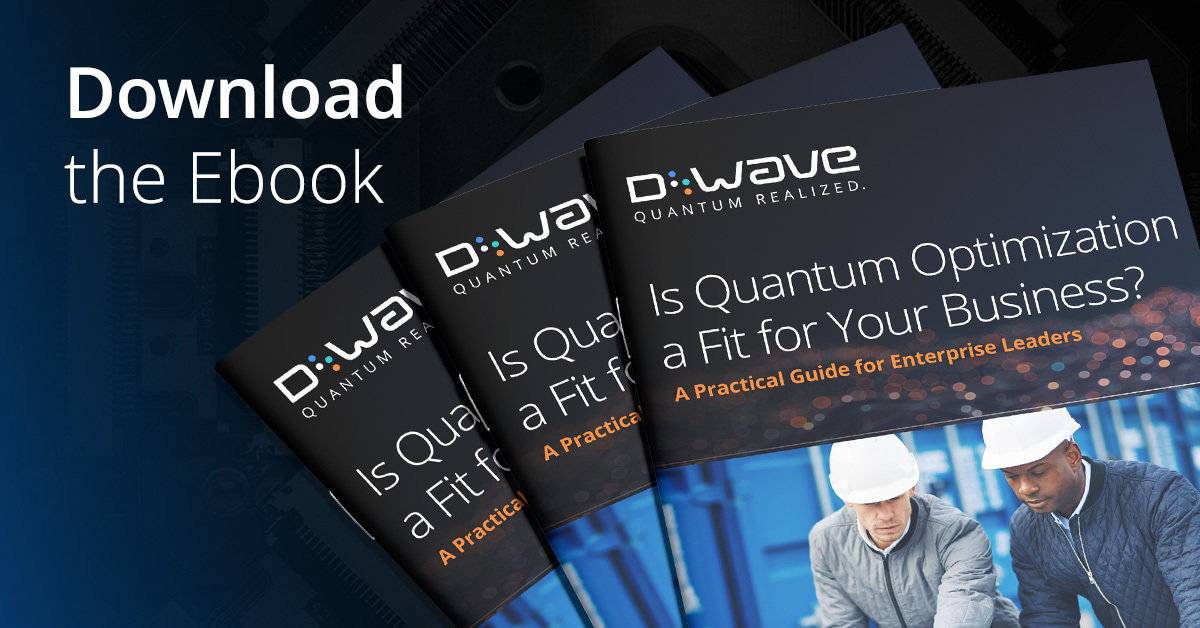
So, how do you know if quantum optimization is a good fit for your business? Start with these seven questions or check out our latest guide, Is Quantum Computing a Fit for Your Business: A Practical Guide for Enterprise Leaders, linked at the end of the article. 

1. What Is Complexity Costing Us?

As optimization problems grow in complexity, trade-offs emerge when using classical-only solutions: 

  • Longer solve times 
  • Rising compute and energy costs 
  • Fewer scenarios explored  
  • Oversimplified models that miss real-world constraints 

Over time, teams stop asking, “What’s the best outcome?” And start asking, “What can we solve in time?” 

If you’re narrowing problems to fit your optimization solvers—that’s a strategic compromise that could be leaving missed opportunities for efficiencies, innovation, and even revenue. 

2. Are Classical Methods Limiting Our Agility?

In fast-moving environments—logistics, manufacturing, supply chains, energy markets, retail—decisions often need to be recalculated continuously.  

Failure to do so can limit companies’ resilience to disruption. Months of careful planning can be upended overnight by unexpected supply chain shocks, geopolitical instability, extreme weather events, labor shortages, equipment failures, or regulatory changes. 

If optimization runs take hours (or days), you can only be so responsive. The faster companies can adapt, the greater their competitive advantage. 

3. Are We Exploring Enough Scenarios?

When compute capacity is constrained, teams often: 

  • Reduce model size 
  • Simplify constraints 
  • Run fewer “what-if” scenarios 

Are we missing insights simply because we can’t evaluate enough possibilities?  

When organizations can test a wider range of outcomes, they can gain a clearer view of risks, trade-offs, and potential opportunities before committing resources. 

4. Is This the Type of Problem Quantum Optimization Is Designed For?

Annealing quantum computing is well suited to address: 

  • Large-scale combinatorial optimization 
  • Many interdependent constraints
  • Problems where solution quality drives measurable business impact
  • Situations where classical performance degrades as scale increases 

Does your challenge match that profile? 

Quantum computing is not a fit for every problem. Small problems that can be solved efficiently with classical methods are unlikely to see additional benefits from quantum computing. The key is using quantum to solve problems where complexity is the limiting factor and where improvement would have meaningful business impact. 

5. Is Our Data Ready for Quantum Optimization?

Quantum optimization cannot compensate for unclear objectives or poor data quality. 

Before exploring quantum, organizations should ask: 

  • Is our data structured, consistent, and accessible? 
  • Are constraints and business rules clearly defined? 
  • Are objectives measurable? 
  • Can data pipelines reliably support regular updates? 
  • Do we have historical data to validate improvement? 

Data maturity often determines success more than technical sophistication. Like any analytical solution, quantum solutions depend on strong data pipelines, clearly defined inputs, and well-understood business rules. 

6. Does My Problem Map to a Proven Quantum Use Case?

Quantum optimization is already delivering results in real-world applications across industries: 

  • Production Scheduling: In a proof-of-concept project, a leading chemical manufacturer used a hybrid-quantum application to reduce their production scheduling time from hours to seconds while improving key performance metrics
  • Network Optimization: A global telecommunications operator reduced network optimization tasks from 27 hours to seconds, enabling more devices to connect during peak demand. 
  • Workforce Scheduling: The largest purveyor of food and healthcare products in western Canada created a hybrid-quantum auto-scheduler for their workforce with D-Wave, reducing scheduling time by 80%, with measurable ROI. 

7. How Does My Organization Get Started with Quantum Computing?

Successful enterprises follow a phased model for quantum computing adoption: 

  1. Identify high-value use case 
  2. Validate problem fit 
  3. Run proof of concept 
  4. Benchmark against classical 
  5. Scale into production 

To begin your quantum adoption journey, start with our new guide, Is Quantum Optimization a Fit for Your Business: A Practical Guide for Enterprise Leaders. You’ll learn: 

  • How to evaluate quantum fit 
  • How hybrid approaches work 
  • What strong business cases look like 
  • A phased roadmap from discovery to production 


If complexity is becoming a competitive bottleneck in your organization, it’s time to evaluate a new approach. 

Our Practical Guide for Enterprise Leaders
Download the Ebook to evaluate whether quantum optimization is a fit for your most complex problems.


A version of this article originally appeared on LinkedIn.

Share this article

More Articles
Stay up to date with the latest lorem ipsum dolor. Sepian monotus
Email Address
By subscribing you agree to terms in our Privacy Policy
and provide consent to receive updates from our company.