Why Classical Optimization Struggles to Keep Pace With Modern Manufacturing
May 5, 2026 | 5 minute read

Article Highlights

Manufacturers face increasing operational complexity that traditional optimization tools struggle to manage effectively. Hybrid quantum optimization offers a new approach to improve scheduling, resource allocation, and real-time decision-making.

Manufacturers have access to more data, more sophisticated software, more artificial intelligence, and more automation tools than ever. 

Yet many plants and factories still wrestle with the same operational failures that have existed for decades: production schedules break down when one variable changes, inventory imbalances ripple across supply chains, and constant trade-offs are made between throughput, cost, and labor constraints. Service degrades, assets go underutilized, and inefficiencies compound into potentially significant bottom line impact. 

Why do these problems persist? 

Because modern manufacturing often involves highly interdependent variables that change in real time, resulting in operational challenges that can be too complex for classical optimization methods alone to solve efficiently. To explore better, faster decisions under constantly changing conditions, many organizations are turning to quantum optimization. 

Why Is Modern Manufacturing Optimization So Complex? 

Manufacturing environments are now defined by interdependent decisions and constant change. Plants must manage a growing number of variables: 

  • Expanding product portfolios and SKU variants 
  • Fluctuating demand and shorter planning horizons 
  • Workforce availability, training requirements, and labor rules 
  • Supply chain disruptions and material variability 
  • Energy constraints and sustainability targets 

Every decision has downstream consequences. 

A change in production sequencing affects material availability. A staffing adjustment limits which lines can run. A late delivery disrupts scheduling, packaging, and shipping. 

Chris Hyatt, a former manufacturing IT leader at Georgia-Pacific and Rainier Advanced Materials, describes it this way: 

“When a digester fouls, a boiler trips, or a key production unit slows down, it creates a cascading effect across the plant. Energy balances shift, throughput changes, schedules collapse. The optimized plan that people spent so much time putting together goes out the window.” 

This complexity isn’t new. But the scale and speed of decisions required in manufacturing today are pushing the limits of legacy optimization tools, which can lead to missed efficiency gains, increased costs and constant operational troubleshooting. 

Why Do Traditional Manufacturing Optimization Tools Fall Short? 

Most manufacturing planning systems were designed for a world where processes are relatively stable, and disruptions are infrequent.  

But that world doesn’t exist in reality. 

Production schedules must constantly adapt to last-minute changes: rush orders, equipment issues, supplier delays, labor shortages, demand shifts. Each change introduces new constraints across the system. 

Classical optimization solutions can struggle with this level of computational complexity.  To cope, they simplify the problem, settling for “good enough” solutions: 

  • Optimizing one objective at a time 
  • Assuming average production rates 
  • Treating resources as interchangeable 
  • Ignoring real-world variability in operations 


The truth is that classical-only optimization approaches struggle to keep up with modern manufacturing complexity, forcing teams to rely on sub-optimal solutions or manual workarounds. 

How Can Quantum Optimization Improve Manufacturing Decision-Making? 

Hybrid-quantum optimization solutions, which leverage quantum and classical computing together, can evaluate far more variables, constraints, and interdependencies than classical-only solutions, often enabling faster and higher-quality solutions. 

Innovative manufacturers are beginning to build hybrid-quantum optimization applications to solve their most complex decision-making challenges. 

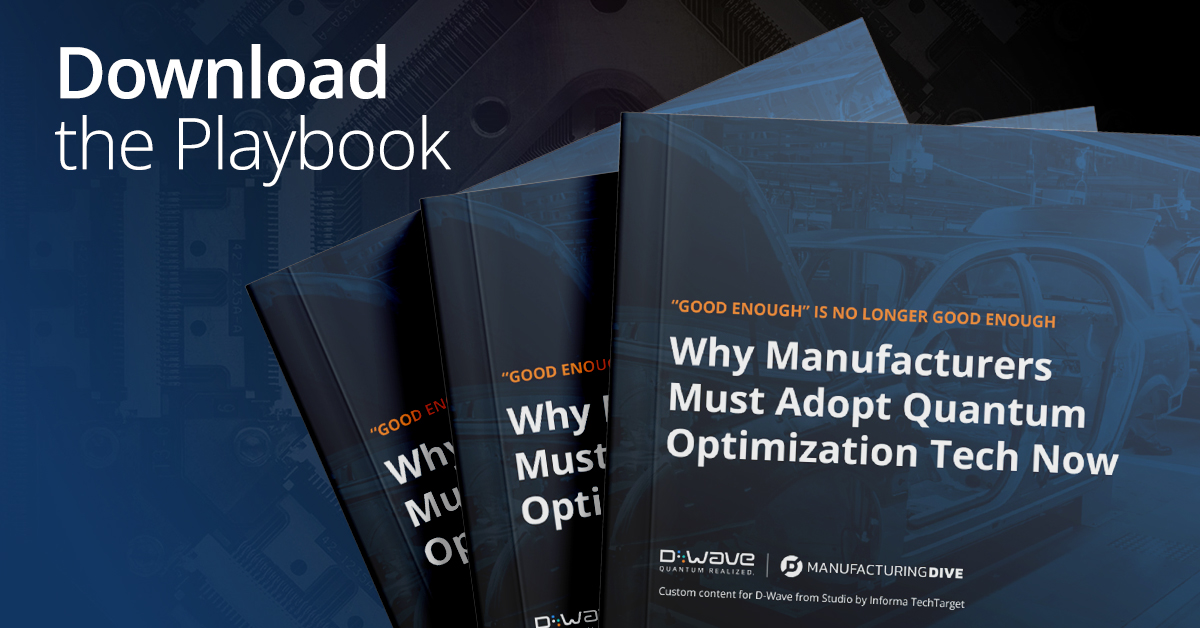
To explore this growing trend, D-Wave partnered with Manufacturing Dive to publish a playbook on how manufacturers are starting to apply quantum optimization to their hard operational challenges. 

The playbook explores: 

  • Why traditional optimization tools are reaching their limits 
  • How companies like BASF are exploring quantum optimization to address real-world operational challenges today 
  • How to start a quantum pilot project without disrupting existing systems 


Ready to move beyond “good enough” operational decisions? Download the playbook to get started.

The Quantum Optimization Playbook for Manufacturers
Download the playbook to learn how manufacturers can apply quantum optimization to their complex problems.

Share this article

More Articles
Stay up to date with the latest lorem ipsum dolor. Sepian monotus
Email Address
By subscribing you agree to terms in our Privacy Policy
and provide consent to receive updates from our company.