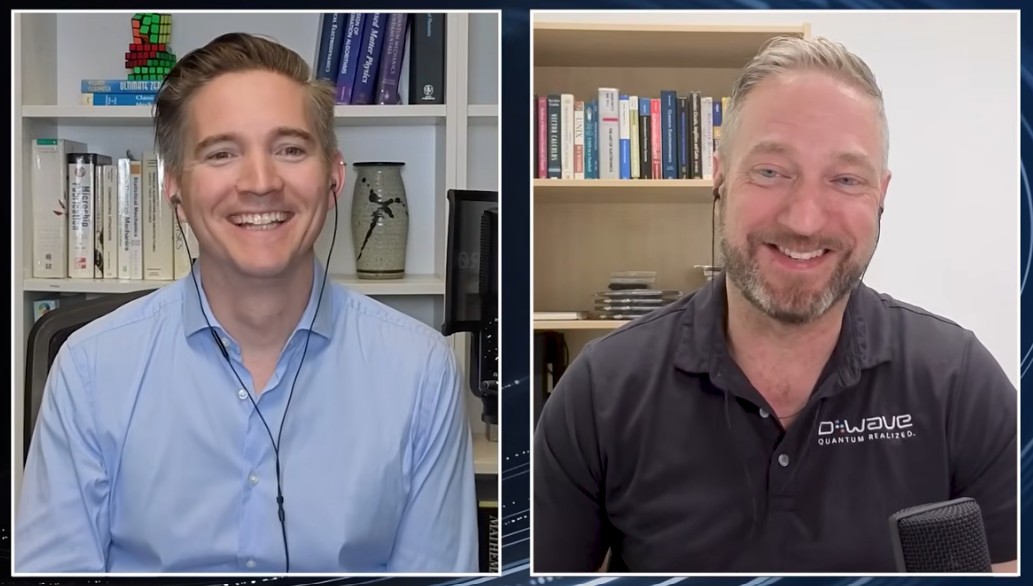
00:00:02Dr. Trevor Lanting: You can think of our systems as pieces of programmable quantum matter that you can shape to run an algorithm to solve hard optimization problems, to potentially accelerate generative AI, or to shape and really drive new discoveries in material science.
00:00:22Murray Thom: Hi everyone and welcome back to Quantum Matters, where quantum computing gets real from D-Wave. I'm your host, Murray Thom, as we move past the hype in the theoretical to explore practical real world applications of quantum computing today and where the biggest opportunities lie in the future. Let's open the box and see what's possible. If you look at quantum computing from the outside, it can feel like a single idea, but inside the field, it's really a system of hardware and software technologies, diverse computational models and user ecosystems and teams around the world are taking different paths to it. At D-Wave, we've taken a unique approach building not just quantum processors, but an entire quantum technology stack and advancing a dual platform strategy that spans both the annealing and gate model quantum computing, all aimed at helping customers realize the value of quantum across a wider range of problems.
Today we're going to talk about what it takes to deliver quantum computing and practice, from advancing hardware to cloud platforms to developer tools, and the thinking behind bringing all those pieces together. Joining me is my good friend, Dr. Trevor Lanting, Chief Development Officer at D-Wave, who leads our product development organization overseeing software, systems, and cloud services. Trevor has been with D-Wave since 2008 and has helped drive the development of six generations of quantum computing systems connecting fundamental research to real world impact. Trevor, welcome to Quantum Matters.
00:01:44Dr. Trevor Lanting: Great to be here, Murray. Thanks for having me.
00:01:46Murray Thom: So Trevor, this is going to be a really fun episode. I think a relatively unique episode. You and I have been working together for over 18 years. We've got more than 40 years of quantum computing experience between us, commercial quantum computing experience and we've been working really closely together. I think there's an opportunity for us to also help shed some light about how the technology has gotten here because most folks that I've met have learned about quantum computing in the last year, maybe in the last two years, or if they've heard about it a long time ago, it was five years ago. And so there's, I think, an opportunity to help people see how the technology has gotten to where it is from that trajectory that it's taken and its development. So first question is going to be, tell us about your organization and what you do there. I want to have a little fun with this because we both work at D-Wave, but I want to hear your take on the introduction. So how would you introduce D-Wave and the work you do here?
00:02:45Dr. Trevor Lanting: That's a great way to start, Murray. I think one of the singular visions and what drew me to D-Wave and what's kept me here for 18 years has been the focus effort of building quantum computing technology to solve customer problems and putting that technology in the hands of our users as soon as it becomes available. This is not a feature technology, this is a technology that's here today and that's really been extremely exciting and is really what's kept me so engaged over the last 18 years. In my role as chief development officer, like you said, I oversee the product development teams and the research and development teams and these teams are multidisciplinary. It takes a vast array of different disciplines to build and deliver a quantum computing technology. So in my organization, we have hardware engineers and cryogenic engineers who are really responsible for developing and delivering the cryogenic platforms to keep our systems cold, to keep them performant.
We have cloud services teams and cloud development teams to make sure that this technology is highly available and that the hands of our users and our customers whenever they need it. We have a processor development team, which are physicists and fabrication engineers really doing a fundamental development. How do we harness quantum mechanics in the most efficient way to solve customer problems? We have algorithms and applications teams that are working on that next layer of code above their bare metal to get the most out of the hardware. And we have service and support teams to make sure that customers as they're engaging with this technology are having a great experience and are really able to unlock its value today. So again, that's a wide range of disciplines and it takes more than a village to build an industry and a technology.
00:04:30Murray Thom: Yeah, that's a good metaphor. Question I want to ask you is one I haven't asked a lot of folks, why is it important to build quantum computers? I have a perspective on that. I want to hear your perspective on that.
00:04:42Dr. Trevor Lanting: I think it's important to build quantum computing and technology because there are problems that we need to solve and tools that we need to solve those problems that just can't be solved with classical technology. And Richard Feynman's original vision around the use of quantum computers to do things like simulating the behavior of molecules, really understanding the fundamental behavior of the universe around us. Fundamentally, nature is quantum mechanical. These systems microscopically, even macroscopically that we are trying to fundamentally understand that really drive immense value for society are quantum mechanical in nature. And so you need a quantum computing technology to really understand how to model and how to discover properties of these materials, how to innovate on novel materials.
But it's also the case where accessing quantum mechanics, being able to run quantum algorithms delivers advantages across a huge variety of use cases. I mean, Shor's algorithm was really one of the main things that triggered the development of the industry and it really showed fundamentally that if you had access to a quantum computed technology, there were things that you could do that were exponentially faster than any known classical approach. And I think as society starts exploring the use of things like generative AI tools, as we actually become more and more dependent on the digital universe around us, our appetite for computing is only skyrocketing. And so I see quantum computing as absolutely essential in providing a tool set to meet the accelerating demand of humanity for compute.
00:06:21Murray Thom: Absolutely. Expanding on that a little bit, I think it's also important to acknowledge that what I thought the quantum computers were going to be isn't what they became. I had an idea of what they were going to be when we first started building them, but along the way, I realized things, I learned things, my perception of their capabilities grew. And this whole notion of tremendously energy efficient computing for hard problems, I didn't realize how big that impact was going to be, but it's so motivating. I mean, if anything, my motivation is even stronger than before.
00:06:51Dr. Trevor Lanting: I mean, when I first joined D-Wave in 2008, the quantum industry was very different quantum computers and what we thought about what the full suite of technologies and products would look like was very different than today. And honestly, the computing landscape in 2008 was very different than it is today. I mean, the last two decades have really kind of shown an acceleration, like I said, and the demand of humanity for computing technology and that's not going away anytime soon and really understanding how our customers are using the technology, the idea that we can make it extremely easy for customers to run problems in the cloud. So you didn't need to be a physicist or computer scientist. You didn't need to have access to direct physical access to a system. You could access this technology at your fingertips through a cloud-based API that wasn't on our radar in 2008, but that's been a critical part of the accelerating adoption of the technology. So it's been very exciting to see the market and the technology and the broader landscape of computing all kind of converged to guide where this technology is going.
00:08:01Murray Thom: There was a time when I was working at D-Wave when you were involved, I should say, with a group of leaders who were tasked with the question of defining D-Wave's culture. We had formed, we are many years into operation and it was like, "Hey, have some conversations internally and let's try to describe what D-Wave's culture actually is." And I loved where you got to with that because the culture that you identified at D-Wave was a culture of teachers and learners. I mean, have you built and developed on that? How do you feel about that?
00:08:32Dr. Trevor Lanting: Yeah. I mean, we built and developed on that and doubled down on it. And there isn't any one person that has all the answers to what we need to be doing, how we need to be prioritizing things. That just isn't the case. I mean, there's a diverse set of perspectives that need to get synthesized into figuring out how we work together and how we force the technology and really being open and collaborative. And I think that interdisciplinary approach of being able to communicate broadly amongst a wide set of experts is important. I think it's something that we've had to learn at D-Wave.
And I've had to learn coming from having the physics blinders on. So there's a way of talking about technology and thinking about things that physicists are trained to do. It's very effective, but also we need to basically figure out how do we talk to mathematicians? How do we talk to computer scientists? How do we talk to people who are engaged with customers? And it's a different type of communication than when you're talking to physicists. And that's a key piece of learning that I've basically had to do over the last 18 years or so.
00:09:43Murray Thom: Well, it's actually crystallizing for me. There was this moment I had spent eight years at Wave building technology and subsystems and then our first customer, Lockheed Martin, purchased one of our systems and set up a lab at the University of Southern California, Information Sciences Institute where they were studying it. And I ended up joining the customer team to go out and talk with customers about it. And at first I thought, "Hey, everyone's going to want to know how these systems are built." And honestly, nobody ever asked about that. They didn't want to know how it was built. They wanted to know how to program it. And as a result, when I was working on the customer team, I was embedded in our hard maths, machine learning, graph theory, like optimization and sampling teams working with Bill Macready there.
And I remember at that time, I had this experience where I didn't feel like there was a complete connection between the processor team, which you were involved with and the algorithms team, which Bill was involved with. And I had this conversation with Bill and I said, "Bill, I think we need to drive this to convergence." And he had this moment where he leaned across this table and said, "Murray, I often don't understand what they're saying." They use these technical terms and then it's like, "And I'm not sure what we're talking about anymore." And I was like, "Okay, hey, that was a great lesson learned. I'm glad I asked them that." So then I went and I met with you and I said, "All right, Trevor, here's the deal. Sometimes your team's coming in, they're talking and using technical terms and Bill doesn't understand what you guys are saying." And you had the same moment, you lean forward, you're like, "Honestly, Murray, sometimes Bill's team uses technical terms. I don't understand what they're saying."
It was like when you've got these diverse groups and these specialties, it's not just the case that the technical language can be difficult for an outsider. It's actually even for other technical fields, it can be difficult to understand. We had to teach each other what some of the physics terms were when translated to math terms and programming terms and we got very good at that and we did that between engineering and the processor team and between the math group and the processor team. How was your thinking developed on this as now as you're communicating much more broadly?
00:11:46Dr. Trevor Lanting: I mean, I remember that conversation extremely well. And I remember because it came out of a frustrating experience that I was having where I was getting anecdotal reports that people were getting bad results out of the system or they didn't understand the results they were getting out of the system. Whereas on the processes side, we're like, "We've spent months calibrating this chip. This chip is great. What is the gap?" And really understanding how they wanted to use the system and that guide is how we thought about, okay, well, what do we really need to focus on in terms of calibrating the system, in terms of benchmarking? And that was a light bulb moment for me. It's like, okay, we have to expand a perspective in how people are using the technology and we also have to be able to communicate and then listen to people who are using the technology because otherwise we're actually not going to build the right thing.
And I think that communication, I mean, we're all speaking English, but we're speaking English differently with very different technical languages. And so figuring out fundamentally what the requirements are, what matters for the mission of say an algorithms team or an applications team and how do you synthesize that with what is the vision and the kind of the requirements and the real care abouts for the process of development team, those things need to get merged and those things need to be linked and it is not trivial to try to bridge those communication gaps.
00:13:17Murray Thom: Yeah. I mean, I think part of the reason why I'm really thinking this is a story that needs to be told is because a lot of the users of quantum computers are innovators in their own organizations and part of innovating is about looking at the world around you and sort of saying like, "Hey, what tools have I got so that I can make this task that I currently find challenging much, much easier to do?"
But I'd certainly learned as I was working with customers that innovation is also about recognizing that you work in an organization, whether it's a company or a government department in the public sector, you work in an organization of people playing different roles and technology and you have to be able to understand those different roles and those different audiences and what they're trying to do and how they communicate with one another because that's a part that you've played at D-Wave extremely well and I think has helped you really excel at the role that you're doing now is being a connector between different groups. And I think customers who are thinking about this technology, it's like, well, we're trying to set them up so that they can be that connector within their own organizations.
00:14:26Dr. Trevor Lanting: That's nice to hear. I think there's still... I feel like it's learning that I am doing and our organization is still doing on a daily basis, but I want to drill in on something you said about innovation because innovation is critical. I mean, it's the lifeblood of our industry. It's the lifeblood of our development program. Innovation comes from in part understanding constraints and requirements and we can't do everything. We want to be doing the subset of things that are the most important for driving the technology forward, but we want our innovation focused on how to move quickly in particular directions. I think that's been critical for driving our success at D-Wave.
00:15:06Murray Thom: Yeah. Yeah. Yeah. So even a chief development officer has constraints is what you're saying.
00:15:09Dr. Trevor Lanting: Navigation of constraints I would say is a daily priority for me.
00:15:19Murray Thom: So Trevor, I want to ask you a question, which is someone who's interested in engaging with quantum computing technology, what should they be looking for in the offering from a quantum computing vendor?
00:15:29Dr. Trevor Lanting: Yeah, that's a great question. I think customers should be applying a framework that we've started applying to our own technology that we call Quantum Realized, where there's several threads to the framework that I think are critical from the customer perspective. I mean, the first is the technology accessible and production ready? Is it available? Can you access the technology when you need it? So what is the uptime of the overall cloud platform and the underlying solvers? So that's really critically important. I mean, I think you want to make sure that you're not accessing R&D prototypes, but you've got a technology that is at your fingertips and ready.
You want that technology to be performed. So you want the underlying technology to be able to deliver advantages over traditional approaches to solving a problem. And in fact, we're quite excited about a paper that was published last year where we demonstrated quantum supremacy on a material simulation problem where we did enormous amount of classical benchmarking and we worked with a team, like a world-class team of experts to really benchmark this particular problem and show that we could solve a problem in several minutes with our advantage to a annealing systems that would take up to a million years with one of the largest supercomputers on the planet.
So what you want to know is the nugget, is the quantum technology able to deliver performance benefit over traditional approaches? And the third thing you want to be looking for is other customer success stories and using the technology. Does the platform have customers that are running enterprise operations, production operations? Are they making good use of the technology today? So through those lenses, like, can I use the technology? Is it ready for me when I need it to solve my problem? Is it fundamentally able to outperform other approaches in solving hard problems and is there a growing set of customers that are actually accessing and using this technology to solve the problem? All of those three things should be giving you confidence that, yes, this is a particular vendor or suite of technologies that I can have confidence in.
00:17:39Murray Thom: So Trevor, I had this experience when I went out talking with customers in the 2011 to 2015 timeframe where I was trying to help people build applications and use the technology. At that time, we were programming at the machine instruction level. So at an early technology readiness level, you're talking a lot about the technology, you're exposing a lot of those details, you're working with some visionary customers and helping them get productive. And what a lot of people don't realize is that nobody tells you what you're missing. There's no like, "Hey, if you just had this, you'd be golden." You're trying to feel that out. And what really came across to me was it was challenging. We needed to make it easier for people to be able to program quantum computers. I mean, what are the elements of our product portfolio that make it much easier for people now in terms of building applications quickly and effectively?
00:18:30Dr. Trevor Lanting: I think there's three things I would point to that we're really focused on in terms of making it very accessible and easy to use the technology. The first, and this has been central to our go-to-market strategy and our product strategy for over six or seven years is our Leap cloud platform. So we want to make our technology accessible with cloud-based APIs where you don't need anything more sophisticated than internet access with a laptop, with a computer, to access a cloud-based API where you can pose your problem to this API and get answers. So that lowering the barrier to being able to access the technology through our Leap platform is one of the big strategic pushes of D-Wave. The second one is making open source tooling available to users to get them up and running quickly. We have an open source SDK called Ocean.
It's a suite of code repositories that allows you to get up and running and formulate problems for technology very, very, very quickly. We don't want our customers to need to know the details of qubit physics to be able to get value out of the technology. And so the Ocean SDK is really that software abstraction layer that makes it very easy to use the technology. And then finally, I mean, the third thing we're focusing on is demos and code examples. So worked examples that are open source and available for everyone to take a look at to see, okay, this few lines of code, I can take my hard optimization problem, formulate it for our technology and show how you submit it to the cloud platform and get an answer back. And so having those worked examples at the fingertips of customers, I think is really, really important.
00:20:14Murray Thom: Trevor, I'm glad you explained that. I want to dive deep into the technology here because D-Wave has a dual platform strategy for quantum computing. We're building multiple models of quantum computing. And I'm going to say that and maybe also just help for the audience when I'm talking about the model of quantum computing, I mean, what is the way the computer's going to use quantum effects to accelerate its calculations, not how is it physically implemented, like whether it's super conducting systems or neutral atoms or ion traps or something like that. So Trevor, what's the importance of the dual platform approach? How does it affect users and what it means for them in terms of their applications?
00:20:50Dr. Trevor Lanting: This is really important. I think this is an example, I think, Murray, that you spoke about earlier where as the industry evolves, it looks different than with what we thought it would look like in 2008. So we made some strategic decisions in 2008 to focus initially on building out and annealing quantum computing architectures for a variety of reasons that have really paid off over the subsequent 15 to 18 years. And it really is around use cases and where you're getting value for solving those use cases from a particular architecture. We chose the annealing systems initially to focus on because we saw them as easier to scale out. The requirements around control of the qubits were a little easier to implement than other architectures. And also fundamentally, we saw a real immediate set of commercial opportunities in the space of quantum optimization where there's a natural fit between solving hard optimization problems and annealing quantum computing architectures.
And really as the last decade and a half have gone, annealing's advantage in solving optimization problems has only been amplified. So really you'll have a long-term advantage in this particular set of use cases with annealing technology, but annealing technology isn't going to solve every hard problem that a quantum competing technology could solve. And in fact, examples like trying to model molecules and do quantum chemistry, that's really the sweet spot for another architecture, the gate model architecture. I'm particularly excited about the set of use cases because I think they're really going to drive value for humanity and the global economy as those technologies mature.
And so the reason why we're choosing to pursue a dual platform technology is that we see complementarity between the annealing technology and gate model technology. They address different use cases, they have different sweet spots and we want our customers to come to D-Wave and not have to think through, "Okay, am I choosing the right company? Do they have what I need that takes to solve these hard problems?" We want to be the one stop shop where we have a broad technology portfolio on the annealing in the gate model side where customers don't have to think twice. They can come to us, we will solve their hard problem with the technology that we have available and that we're developing.
00:23:09Murray Thom: Yeah. I think that approach is so critical. It's we're not starting from the technology up. We want our customers to begin by saying, "Well, this is the application that I need to accelerate." And then we'll bring the appropriate technology. And in some cases that's direct to QPU technology, either on the annealing side or on the gate model side. So I think that's critical. I mean, I think maybe the other point that I would build on, which is important to note is that that focus on end customers and their applications, there was another element to that that really brought annealing to the fore, which is you don't need to know quantum mechanics to program it and that makes it a natural starting point. A lot of people are like, "Oh, you want to learn how to program quantum computers? Let me teach you quantum mechanics first." It's like, "Oh man, there's so many people I know who don't want to become quantum physicists." So there are certainly those important problems.
There's quantum mechanical problems and molecular simulation problems for which the gate model is really well suited, but then there's also those applications which you can learn quickly with high school level mathematics and Python programming skills. Now, if I was meeting someone for the first time and talking to them about quantum computing, which happens on a daily basis for me, I'm not going to try to introduce too much at first, but I'll tell them, look, the lessons learned and the experience of building our annealing technology and getting it out to production, that plus the technology that we have access to on the gate side, that's what sets us up to be the fastest to commercialize gate model quantum computing. But I think here with you in the room, there's an opportunity for you to say like, "Well, why is that the case? Why are we set up to be the fastest to commercialize gate quantum computing?"
00:24:43Dr. Trevor Lanting: There's a couple of threads to that that I think give us a unique advantage or a couple of pillars that give us a unique advantage. The first is we've learned some incredibly valuable lessons and have incredibly valuable technology from the scaling of our annealing systems. So our annealing systems are now at the many thousands of qubit scale. Our roadmap has them continuing to scale up to even bigger sizes. That's taught us some good lessons about architecture, good lessons about calibration and good lessons and technology around on-chip local control to minimize the number of lines that need to go into your cryogenic enclosure to control your system. And this is really incredibly important. I mean, if you think about the laptop, the chips that are in your laptop or the chips that are in your phone, I mean, those integrated circuits have tens of millions, billions of components, but you have only maybe a few hundred control lines that are going in from say the circuit cars into the chip to actually control the chip.
And that's because there's on-chip digital logic, demultiplexing and multiplexing to really be able to control a large number of devices with a finite or fixed number of control lines. That's been central to our strategy for how to scale out the annealing technology where our advantage to technology has over a hundred thousand individual programmable DACs on the chip that we're controlling with less than 300 lines and we're intending to keep that line count relatively fixed as the technology scales. So in all of that technology, we're adapting for driving and scaling our gate model architecture. So that's the first fundamental pillar is that we have expertise over the last 20 years in the cryogenic control and the local onship control that we will be adapting for the gate model architectures. The second one, and this really comes from the quantum circuits merger and the team that we brought on earlier this year, they have a superconducting technology called a dual rail qubit that is incredibly good at driving fast gate speeds with high fidelities.
So the dual rail technology really allows you to get the best of the superindecting world and getting very fast, sort of tightly coupled qubits for fast execution speeds, but the ability to dual rail technology allows you to drive up the fidelities and get very high fidelity one and two cubit gates. And so this fundamentally is going to allow us to shrink the requirements for error correction by at least a factor of 10. And this combination, having the fundamental qubit technology be much more efficient at error correction because of its architecture and its error hierarchy and us having the expertise in how to engineer control at scale are coming together and I think really are the two fundamental reasons why we're going to pull ahead of the industry over the next several years to deliver scaled gate modeled systems.
00:27:50Murray Thom: I'm going to bring up a topic which we could probably do a whole hour long discussion, but there's just so much interest about the intersection between quantum and AI. So I'm just going to constrain you a little bit here in a short answer, but what work would you like to highlight there?
00:28:07Dr. Trevor Lanting: But the higher level statement I want to make is that these technologies are complimentary. So AI technologies require an immense amount of compute, some of which is extremely energy intensive and can benefit directly from our quantum computing technology. And the work that we're doing right now at D-Wave is investigating how can we, the best make use of our annealing QPUs to really bend the cost curve and energy consumption for frontier AI models and for the data center buildup that's currently underway across the planet. And fundamentally what we're looking at is harnessing the ability of our QPUs to produce diverse high quality samples from a distribution that can be trained. And if you can do this and you have a set of very high quality samples, you can plug those into a generative AI model like a diffusion model for image generation and potentially get an advantage in the overall training time footprint or the overall rest of the neural net, like the deep learning network in terms of its complexity, or even just the time it takes to actually do inference.
So the work we're really doing currently is how best to leverage this fundamental computational nugget that our annealing QPUs are really good at, which is generating diverse high quality samples from these distributions that are extremely hard to sample from classically. And we see a huge amount of opportunity there as we build out that research program. But there's the other direction, like how can AI technologies accelerate quantum computing technology that has us also quite excited. I mean, there's a lot of different groups in the industry that are looking at ways to use, say, Agentic AI to accelerate calibration that can improve the performance you're getting out of the systems. So there's a bidirectionality to this complementarity, the AI and quantum. I think the thing that I am the most excited about though is harnessing the QPUs fundamentally to give computational power to really enhance AI models and really bend that energy cost curve.
00:30:11Murray Thom: Yeah. And it's accessible too. I mean, we've got PyTorch plugins and Scikit-Learn plugins showing people how to build components for quantum and artificial, quantum use and artificial intelligence. And there's organizations like Shionogi who are using it for drug discovery applications. Triumph is using it as they're looking at these particle accelerators, how can they reduce the energy consumption in their use of AI for simulating the reactions that take place there? Julich supercomputing centers looking at it from protein DNA binding. I mean, there's so many fascinating applications for it, so that's a very exciting area of exploration. Is there anything, Trevor, that we haven't covered so far? Anything that you wanted to make sure that we got a chance to share with folks?
00:30:48Dr. Trevor Lanting: I think one of the other areas that I think you're going to see a lot of from us at D-Wave over the next several years is analog simulation of quantum systems for accelerating materials and scientific discovery. So I mean, that's a very physicsy mouthful of a sentence that I just said, but I mean, this goes back toward one of the visions for quantum computing systems is the ability to fundamentally make new discoveries about materials, new discoveries about quantum systems that you just can't do with classical approaches because the systems that you're trying to model fundamentally are quantum mechanical.
And there's just a vast array of things that are currently gated by our inability to model them classically that just open up as this technology matures. And so I think we have a lot of people internally very excited and working on the different use cases of features and how we harness our annealing KPUs. And the phrase I like to use is that you can think of our systems, both our game or our annealing systems as pieces of programmable quantum matter that you can shape to run an algorithm to solve hard optimization problems, like I said, to potentially accelerate generative AI or to shape and really drive new discoveries in material science. And that's very, very exciting.
00:32:09Murray Thom: I'm geeking out over here. Like I said, my motivation just gets stronger every day. Okay. Imagine you were going to give yourself advice at the start of your journey with quantum computing. What do you wish you would have known then?
00:32:24Dr. Trevor Lanting: I think I was slow to build communication bridges and lines of communication to other technical teams when I was first starting out on my journey in quantum computing. And the advice I would give to myself is talk to more people, as many people as you can about how they're thinking about the technology, not just the physicists, not just the teams that are more hardware focused, but talk to a very, very wide swath of people. And I think that doing that even sooner than I did, I think that's the advice I would give to myself.
00:33:04Murray Thom: Awesome. Trevor, I mean, I love the discussion. I always love a chance when we could sit down together. This has probably been our longest conversation in a while because you're a very busy guy. So it's been fantastic having you on the podcast and thanks for being part of Quantum Matters.
00:33:18Dr. Trevor Lanting: Thanks, Murray. It was definitely a pleasure. It was a great conversation.
00:33:24Murray Thom: I'm sure you can tell, Trevor is a good friend of mine and I always enjoy an opportunity to sit down with him and talk about quantum computing, revisit some of the journey that we've been on, but also think about what's important for the end users and customers who are looking to use this technology and create some transformational value with it. Everything from why building quantum computers is important, what kind of products we're actually offering and what they're used for and how we can make that easier for folks to be able to build applications quickly as well as how we made those decisions and what was the intent behind those decisions. So I hope we gave you a little bit of a peek behind the curtain so that you could get a strong sense for that and really understand the technology much more deeply.
That's it for this episode of Quantum Matters. Thanks to you, our viewers and listeners for joining me. Please follow so you don't miss an episode. And if you want to learn more about what we discuss today, D-Wave's quantum computing products, how to program them, how to make it easier to build applications, visit the links in our show notes. There's lots of information online. Until next time, I'm Murray Thom. Stay curious about your quantum reality.