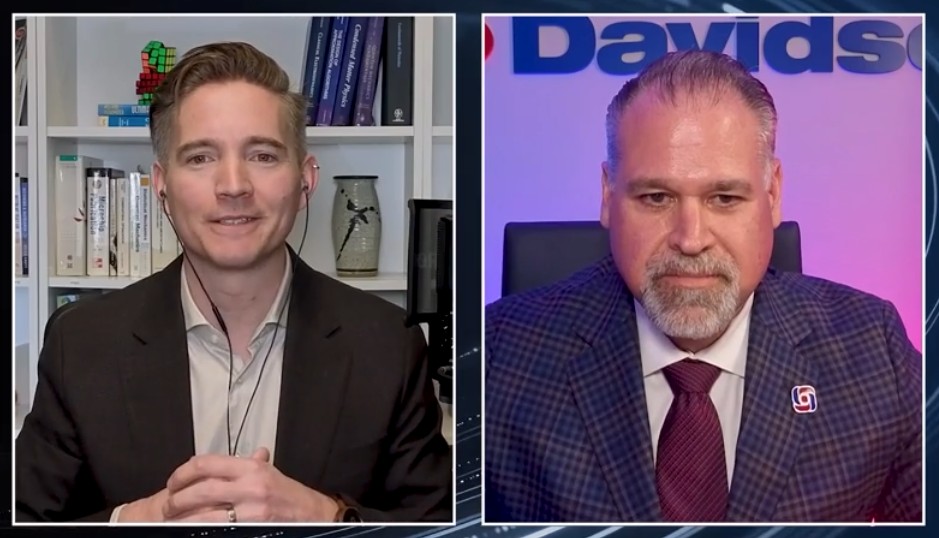
00:00:03Dale Moore: The world that we work in has very serious consequences when things fail and I'm not willing to bet my family's life on the fact that we're not ready to defend against technologies that continue to advance because we weren't willing to invest in it ourselves.
00:00:27Murray Thom: Hello, and welcome back to Quantum Matters, where quantum computing gets real, from D-Wave. I'm your host, Murray Thom, as we move past the hype and the theoretical to explore practical real-world applications of quantum computing today and where the biggest opportunities lie in the future. Let's open the box and see what's possible. So far on Quantum Matters, we've explored optimization across logistics, manufacturing, and robotics, but today, we're stepping into the defense sector. On this episode, we're looking at how quantum computing is being applied to mission-critical national defense, specifically in air and missile defense planning, where critical decisions must be made at scale and under time pressure.
The advantage of quantum hybrid in this case isn't theoretical, it's operational. It's what enables improved threat mitigation using a fraction of the time of other solutions when evaluated in highly complex scenarios. Here to tell us all about this fascinating work is today's guest, Dale Moore, President and CEO of Davidson Technologies. Davidson is working at the intersection of advanced defense systems and emerging technologies, collaborating with Anduril and D-Wave to develop quantum hybrid solutions for air and missile defense. Dale, welcome to Quantum Matters.
00:01:40Dale Moore: Thank you, Murray. It's a pleasure to be here.
00:01:42Murray Thom: Dale, I'm going to begin by asking you to tell us about Davidson Technologies and the work you do there. And I think people might get a bit of a chuckle because you're the president and CEO of Davidson Technologies, so they might think, "Hey, he just runs the place," but I also think they would really appreciate hearing you speak to it.
00:01:59Dale Moore: Well, let me first give you just a quick overview of who Davidson is and what we do. Davidson is a 30-year business that has always been focused on very complex national security problems and developing technologies that solve them. We are focused as we move forward on advanced technology implementation. And so our mission is to innovate with purpose, deliver with speed, and empower the war fighter.
And so what you see from Davidson on a daily basis is going to be focused on those three things with a vision really to enable secure information-dominant solutions and decision advantage algorithms and really solving very complex war fighter problems. My job as CEO, obviously the simple answer is yes, I run the business. Yes, I'm responsible for the success or failure of the company, but more than that, we are striving to be one of the best companies in our space, both from a technology standpoint and from a culture standpoint.
And so I try to set every day an example of what that means. And it means, obviously, hiring great people and empowering them to do their jobs in support of our customers and the mission spaces, but it's also about creating a culture where elite talent thrives and these types of problems energize our business and the employees who work for us. And so I have multiple jobs in this company to include chief growth officer, chief financial officer, president and CEO, but we're a small business, and so that's just what it takes to keep things going. But excited to be here and I appreciate the opportunity to have a chat.
00:03:42Murray Thom: That's right. You've got your hands in the work and working alongside folks. I definitely feel that as well working at D-Wave and the size that we are. Now I think a question that you're going to be able to provide a unique perspective on here is that from the CEO's lens, how did you get started in quantum computing and why was that initiative important?
00:04:02Dale Moore: As we were maturing the company and really looking at how do we as a small business differentiate ourself in a very competitive market space? We felt like that quantum was going to be a future enabler and we're starting to see that certainly, but it just made sense for us to one, it was a good fit from an optimization standpoint and some of the algorithms that we have been focused on developing for decision-ready solutions and advanced compute platforms. It just made sense to combine these two and we were very interested in how Quantum as it matures will be an enabler. The one thing we didn't realize was that there was an actual operationally commercially viable system out there and that's where the partnership with D-Wave became very, very obvious.