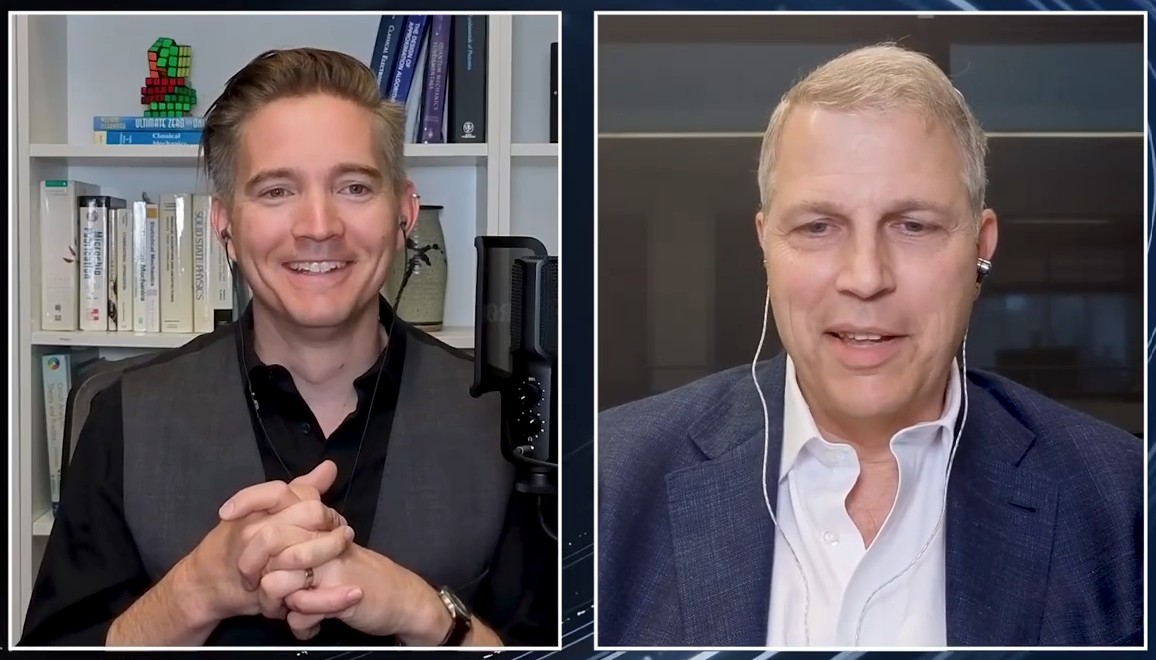
00:00:01Robert Schoelkopf: The pace of progress is continuing to accelerate and we're learning new things every day. We're also getting really beneficial insights by working with people on the theory of how these machines should work. And as we make more complicated systems, it leads to new insights, which leads to better ways to construct them, and there's a real sort of virtuous cycle going on.
00:00:29Murray Thom: Hello, and welcome back to Quantum Matters, where quantum computing gets real from D-Wave. I'm your host, Murray Thom, as we move past the hype and the theoretical to explore practical real world applications of quantum computing today and where the biggest opportunities lie in the future. Let's open the box and see what's possible.
The world is filled with complex, sophisticated, and interesting problems. No one quantum computer is going to be able to accelerate them all. At D-Wave, we're taking a dual platform approach, building both annealing and gate-model quantum systems. And while the full history of quantum applications hasn't been written yet, we do already know that each model accelerates an important application domain that the other cannot. Annealing will always be the exclusive choice for accelerating optimization, and gate will likewise be the exclusive choice for accelerating direct molecular simulation.
In our previous episodes, we've been talking about quantum computers based on the annealing model, and today we're going to be focused on gate. And just a heads up, this one's a little heavier on the technical language, so feel free to check out the glossary in the show notes.
All right, for our last episode of the season, it's a great honor to welcome Dr. Robert Schoelkopf, co-founder of Quantum Circuits Incorporated, which was recently acquired by D-Wave and now chief scientist at D-Wave. Rob is Sterling Professor of Applied Physics and Physics at Yale University and founding director of the Yale Quantum Institute. He's also widely recognized as one of the pioneering figures in quantum computing. Rob, welcome to Quantum Matters.
00:01:57Robert Schoelkopf: Hi, Murray. I'm glad to be here.
00:02:00Murray Thom: Fantastic. Now, Rob, you have three decades of experience in quantum computing, and you have been such a pioneer. You've developed a lot of the core technologies that are being used by quantum computing companies throughout the industry. A lot of your students and collaborators have gone on to lead groups at prestigious universities like Princeton and Stanford or work in industry at places like Google Quantum AI and AWS. And I think there's an opportunity for us to have a conversation and really kind of highlight what are some of the patterns we're seeing in the quantum computing space? But before we get to that, I want to talk to you about the first time you learned about quantum computing. I mean, I think when you were beginning, you were studying and working with quantum systems, but what was your awakening to the idea of quantum is computation?
00:02:46Robert Schoelkopf: Right. So yeah, my PhD research was actually on superconducting devices for millimeter and sub-millimeter wave radio astronomy. And I was a postdoc here at Yale where we started applying some of those microwave techniques to doing precise and high-speed measurements on electron transport in small circuits and small structures. And we had developed a method of measuring the charge on a small metal island in sort of sub-microsecond times, and then we learned about these ideas of the Cooper-pair box and superconducting qubits and sort of realized, "Hey, this is the measurement technique you need in order to be able to detect things like the actual coherence time of superconducting qubits." And that was coincidental just a couple of years after Shor discovered his algorithm and put forward the idea of error correction, and so everyone was sort of starting to think about how could we actually make a quantum bit, make a qubit that's controllable and engineerable.
00:03:54Murray Thom: It's interesting because when we look back at history, we're like, "Oh, these events happened. Everyone will have appreciated Shor's algorithm and what that means for information processing." But it really is a couple of years time for those ideas to kind of sink in. So it was sort of diffusing into the conversations in your team because obviously like you were describing, the applications you were thinking about for those devices was radioastronomy, detection, that kind of thing. So it was sort of like gradual process, is that right?
00:04:19Robert Schoelkopf: A little bit. I think there wasn't a full appreciation or respect for the ideas of quantum computing among the sort of pure physics crowd at the very beginning. And that's changed over the years. But I think we got into it because it was fascinating science and a really interesting fundamental question like, "Can you actually make a manmade object that acts like an atom or a single photon?" And there was this idea that, yeah, if it worked, maybe it would someday turn into quantum computers or something like that, but we didn't really expect it to work when we started, if I can say.
00:05:03Murray Thom: Right?
00:05:03Robert Schoelkopf: Yeah. And in a way, the progress in the field and the increase in the rate of discovery has been surprising even to me. It's really going faster and faster and faster and there's success piled on success, and now I think we're really confident that these machines are going to make a big change in the world. And so it's been really exciting to be along for that entire ride.
00:05:30Murray Thom: Yeah, it's fascinating for me because I spent some time reading some books about the industrial revolution and technological development because it was sort of like, how did we get to the point where we are today? And there was a part of that story about the development of clocks where the idea of keeping time became important. It was sort of a concept that ended up becoming important for navigation, but the technology for clocks had to be developed and it involved the control over materials that we could use to build into the componentry that made clocks. So in a similar way, the human race has now got control over quantum matter. We can study it, we can control it, we can start to engineer it. And as a result, we're learning how to turn it into an engine of useful work for us.
00:06:12Robert Schoelkopf: Indeed.
00:06:16Murray Thom: Looking at the overall quantum computing industry and drawing on your insights, with all your experience working on quantum computing and so many of the leading groups in academia industry, what do you think the quantum computing industry has been doing wrong?
00:06:29Robert Schoelkopf: Well, I think in a nutshell, my point of view is that people started trying to scale up a little too soon. And a lot of the efforts have kind of focused on brute force scaling of the established techniques that we used to do the first quantum algorithms in our university lab in sort of 2008, 2010 era. And so there's been a lot of progress and people have made now quite complex machines, but I think you're seeing that it's tough going and maybe the first thing that you ever create is not necessarily the thing that's going to win in the end and be suitable for really scaling up to large levels. And that was kind of the thesis of both my research at Yale in the 2010 to 2020 era, and also the idea behind the founding of Quantum Circuits was let's invent a more stable qubit, a higher performing qubit that's going to make the job of scaling easier.
00:07:41Murray Thom: So, Rob, is that the flip side of the coin rather than what's been going wrong in the industry, I'm wondering what is new and what are you most excited about at this point in time?
00:07:49Robert Schoelkopf: Right. Well, we've learned a lot in particular about this task of error correction, which is really the thing that's necessary for building fault-tolerant gate model machines that can do really hard problems. We both now know some of the shortcuts one can take, the things that make error correction easier, and we've developed better, more stable qubits and better ways of controlling them. And so I think that makes me much more optimistic now about the path forward in terms of scaling these machines and making fault-tolerant systems in the next several years.
00:08:28Murray Thom: So let me put this into context for the listeners, which is that if we think about the computers of our everyday lives, like the laptops that we use or our phones, there are computer chips in there that are processors; they are doing information processing for us. And the fundamental building blocks of those devices are actually quite simple. They're transistors. And transistors, like an analogy for a transistor is like a light switch. You turn it on and current flows and you turn it off and current stops flowing. Through the course of the last 70 years of development in computers, transistors have actually gone through several different stages of development. We had NMOS, CMOS, we've got FinFETs, Gate-All-Around, and nano sheets. Something similar has happened in quantum computing. I mean your core expertise are on these core devices on the quantum computing side instead of transistors, they're qubits.
You were involved in the invention of the transmon qubit, of the cat qubit, of the dual-rail qubit. Can you talk a little bit about that arc, where you first started and what has kind of led you on that pursuit and guided you towards these new technologies?
00:09:30Robert Schoelkopf: Yeah, I mean when we conceived of and then implemented the first transmon qubits, it was a big step forward in terms of the stability and reproducibility of the qubits. And it allowed us to start doing things routinely with multiple qubits. But as I was saying before, that's not necessarily good enough to make something which can really suppress the errors to the level that's going to be needed.
So you were talking about conventional computers and the bits in conventional computers, and something we take for granted is that those bits are rock solid. They are never going to change their state in a way we don't want them to. And so you actually don't need that much redundancy or robustness in your computer because the bits themselves are so reliable. And so there's been this kind of progression of things where we tried to make qubits that, as I said, were easier to use for error correction or were inherently more stable, or that have functionality that sort of lets you flag when they go wrong and therefore get some extra information and a leg up for the error correction itself.
00:10:51Murray Thom: I want to dive into this a little bit, but I think an analogy is going to be really helpful. And an analogy I often use is building an ice sculpture, where building the ice sculpture is the application. So if we were trying to simulate medicines at the molecular scale, this is the analogy for that. Then I describe how do the quantum computers actually construct the ice sculptures? And in annealing, it constructs it all at once. The effort in programming it is in programming a mold, which then gets applied to the ice and forms the ice sculpture. And that has a lot of value and a lot of uses, except if you're trying to build an ice sculpture that might have hollow volumes in it, in which case the casting is a limitation in that kind of a molecule or ice sculpture. And so in the gate model, what it allows us to do is to build the ice sculpture up from small blocks of ice and construct it that way.
Can you use that as a context to help us understand these new devices and their capabilities?
00:11:38Robert Schoelkopf: Sure. In gate model, we start with qubits and we program with individual steps in time. And so it's a bit like building little blocks of ice and then stacking them up on top of each other in some complicated way to simulate, as you say, the configuration of a molecule or the like. And what's really important, of course, if you're building up those blocks is that they are precise enough and stable enough. And the challenge with quantum bits is that there's noise, or in this analogy, the blocks are trying to melt on you. And what we need to do is have blocks that are more stable and melt more slowly, and we need to have ways to go in and fix that, refreeze the blocks by performing error correction, and then making the entire structure robust, standing on a good foundation.
Now, the other thing that's important with that is, of course, if we're building things up step by step, we want to be able to complete the task as quickly as possible and quicker than things are melting, and so it's important that the speed at which we can program these steps, these gates, is as fast as possible.
00:12:56Murray Thom: Rob, you're at the front lines, working with these quantum mechanical devices themselves. You're engineering them. You understand what the needs are of the quantum computer itself, and you're looking at these sophisticated devices and figuring out how can I engineer these so that it's combining these needs together into a single engineered device? I mean, how transformative is that in terms of your view of quantum computing as a whole?
00:13:19Robert Schoelkopf: Right. So there's been incredible progress in our capabilities of controlling these quantum bits. So we've gone from just being able to do a handful of operations before the noise sets in, to being able to do thousands or even millions of steps. And in particular, in the last few years, we've seen great leaps forward in this performance of the devices. And in particular with this dual-rail qubit that we invented, we now have a system which is high enough performance that you can really see a path forward to scaling.
00:14:00Murray Thom: Okay. And Rob, I want you to put that in the context. Can you talk about that in terms of how you would characterize the pace of progress in the whole quantum computing field?
00:14:08Robert Schoelkopf: Well, the advances that people are making are really incredible. I think the pace of progress is continuing to accelerate and we're learning new things every day. And we're also getting really beneficial insights by working with people on the theory of how these machines should work. And as we make more complicated systems, it leads to new insights, which leads to better ways to construct them. And there's a real sort of virtuous cycle going on.
00:14:37Murray Thom: Yeah, I like that point about a virtuous cycle. I mean, once those virtuous cycles can get set up in an industry like this, then you're getting compounding returns where everyone is helping everyone make more progress quickly.
Rob, I want to ask you about something that I've seen in the quantum computing industry over my decades of working in the space, you've been working in the space for a very long time, and that's that I've really seen separate communities in the quantum computing domain in terms of the models of annealing and gate. And part of the reason why those communities I see as being separate is because the two models took their inspiration from different fields. In annealing, it took its inspiration from optimization and material science where everything is kind of interconnected and it needs to change altogether. In gate, took its inspiration from computer science, which is like, "Hey, we're going to set up a memory register and then we're just going to make some logical operations on it in a sequence over time."
And if we connect that to the analogy, the ice sculpture analogy we were talking about, you've got a group who are forming ice sculptures by casting them with molds, you've got a group that are building them up with ice blocks, and you can sort of see how they would be talking past each other. You're just like, "Oh, your computer, how fast is it? Well, how quickly can you stack ice blocks?" It's like, "Well, I'm not stacking ice blocks." There's a missed opportunity at mutual understanding and communication. I mean, what do you think about this? Does this resonate with you at all?
00:15:59Robert Schoelkopf: Yeah, I mean, these really are quite different paradigms. And so in my career, I've basically exclusively focused on gate model and the development of those kinds of systems, and it's not so clear what the metrics or the points of comparison between the two would be other than I suppose discussing what are the problems that can be solved. So I think the proof of the pudding comes in the use cases, and those are also likely to be quite different for the two different modalities.
00:16:36Murray Thom: Yeah, I think that's a really good point. I mean, I think that one thing I've always tried to recognize is that we understand the technologies in our lives through the applications that we use them for. And as we're using these technologies to perform useful work for us in those applications, that then creates a foundation that we can use to build that understanding with one another.
Okay, let's talk about a topic that often comes up, which is hype. And hype itself is a term that's used so frequently, I kind of feel like it's lost connection to its roots. And I can see how people are building new technologies, they're trying to estimate what their capabilities are going to be in the future. There's sort of a cone of uncertainty. The further out they go, the less certain they are. There's a certain kind of hype that I think should be at least not accommodated, but understood, which is sort of born of misunderstanding.
But there's a more problematic form of hype, which is just lying. And there's some real Pinocchios out there making claims perhaps because they need to, not because they're accurate. I mean, what do you think is the impact of exaggerated hype?
00:17:42Robert Schoelkopf: Yeah, I do worry about the impact that that can have on our field. I think as a scientist, of course, I'm really used to being much more cautious about the claims and stating what is known today as opposed to what you imagine can happen in the future. And so things are changing quickly, there's a lot of activity in a lot of different directions in the space overall, and so it is hard to predict the future, but I think there's a temptation for people to default to telling the rosiest possible version of the future and not putting the necessary caveats and cautions into the story. So I think this technology is coming and I don't think it needs to be hyped, and so I think it would be better if people were a little bit more circumspect.
00:18:47Murray Thom: Yeah. I mean, it's interesting because even sitting in the chair where I am at, I mean, you're a professor at Yale and I'm an evangelist. So I can even see it in our conversation where I can see the way that you're using language and you're tying things to specific measures or accurate terms that are really focused on making sure that folks who are listening to that and might re-listen to it will really understand, "Oh, okay. Yeah, this is actually a very precise language, a choice of language."
And my circumstance is quite different. I'm out talking with folks who have never heard about quantum computing before, and I'm trying to ground it in familiar concepts for them. And to some extent in my journey, I understand I'm not going to be able to get them all the way there. The first starting point is just helping them discover a little bit of what's exciting. And I think that's a separate type of misunderstanding. It's part of the journey towards understanding, which is very different from the problematic form of hype.
00:19:49Robert Schoelkopf: I guess there's kind of a challenge with quantum information, which is it's a set of very new paradigms and they're complex and unfamiliar to a lot of people. And so when describing this to the broader audience, simplification is necessary, but it's not easy to simplify sufficiently and keep the core truth or reality present. And I think that's one of the challenges that we all face. And I respect your role and the need for people like you in the field, but it's not an easy thing to translate from the very complicated science into simple concepts or takeaways for the average person or user.
I mean, as technologists, we care a lot about the technological differences and exactly how you make it. As a user, you don't care how elegantly the technology was developed or built. You care about what it can do. And so that's kind of the ultimate proof points are what's possible with these technologies.
00:21:03Murray Thom: Yeah. Yeah. I mean, it's connected to the fact that at the lowest possible layer, what classical computers are doing is addition and multiplication. So those are understandable classical concepts. So at least in those analogies we might use in metaphors, there's a basis that still is relatable for folks' lives. But as humans throughout the 20th century, we struggled with understanding quantum mechanical systems and we had to develop very sophisticated mathematics in order to describe them. And so this is why I find the question of how do quantum computers work is the hardest question to answer because it's the most closely connected to that sophisticated description of the world that takes more time to build on or build up.
00:21:48Robert Schoelkopf: Yeah. But on the other hand, today, if someone's using a smartphone or a laptop, they don't need to know anything about how integrated circuits are built. And they can appreciate that it's magic and that they get twice the storage in a year and all of those kinds of amazing things, but they don't really need to know how things work at the core.
With quantum, we're kind of not there. We're trying to explain how it works and what it can do. And eventually there'll be a transition where it's just, okay, I'm using quantum to solve this problem. I'm using it to solve that problem, and it's cool that it's different, but that doesn't really make it something I need to worry about on a day-to-day basis.
00:22:31Murray Thom: Well, let's connect that then to the mission here, the impact. I'm curious to know what applications and what people do you have in mind? Who do you dream of having a positive impact on with quantum computing?
00:22:43Robert Schoelkopf: I think as with any new technology or capability, maybe the first applications will be in scientific discovery. So we think that with gate model computers, it's going to be fighting quantum with quantum, having problems like molecular design or discovery of new materials, which are hard to compute and hard to simulate because they are intrinsically quantum mechanical problems. So now we have quantum computers that can basically be programmed to emulate both things that we know of and that exist and new crazy things that we might be interested in seeing if they can exist. So I think it will be first impactful on the scientific community and on folks like the pharma industry or materials industries.
00:23:40Murray Thom: Coming full circle to that 1982 lecture by Richard Feynman, Simulating Physics with Computers, where he was saying, "If you want to make an accurate simulation of nature, you'd better make it quantum mechanical because nature's not classical."
00:23:53Robert Schoelkopf: Right.
00:23:54Murray Thom: Let's look ahead a little bit here. I mean, in your eyes, what does success look like with quantum computing technology?
00:24:02Robert Schoelkopf: Well, for gate model, I think the next step is showing that we can really make robust and fault-tolerant systems. So that means demonstrating that error correction, fixing the blocks as we're assembling is something that can be done and can be done in a way which is robust and performant enough that you can really scale these kinds of systems.
And then in concert with that, I think we're going to be learning a lot about how you program these machines as we're able to make larger and more complicated devices.
00:24:37Murray Thom: Well, Rob, it's been great having you on the podcast and getting a chance to share our mutual excitement of quantum technology, so thanks for being a part of Quantum Matters.
00:24:44Robert Schoelkopf: Thanks, Murray. It's been fun to chat.
00:24:49Murray Thom: I have to say what an honor it was to have Rob Schoelkopf on the show today. Certainly when I started in quantum computing, he was already famous and it was great to get a chance to explore some of these ideas and patterns that he's seeing and I'm seeing in the quantum computing industry. I also really appreciated his perspective about how our improving engineering control over quantum devices and our ability to program those systems and then build them into systems and that involvement from that broader community is creating this compounding benefit that's actually accelerating the industry and progress in the industry.
And it was also really fun for me to connect with Rob about communicating ideas about quantum computing to different audiences. Rob, from the perspective that he's a deep quantum expert, he can talk to people who have incredible depth in the field and help them understand it better, very much late in their journey, and I'm helping people often at the beginning of their journey to understand the technology and how it's going to impact their lives.
That's it for this episode of Quantum Matters. Thanks to you, our viewers and listeners for joining me. Please follow so you don't miss an episode. And if you want to learn more about how to get started with quantum computing, visit our links in the show notes. Until next time, I'm Murray Thom. Stay curious about your quantum reality.