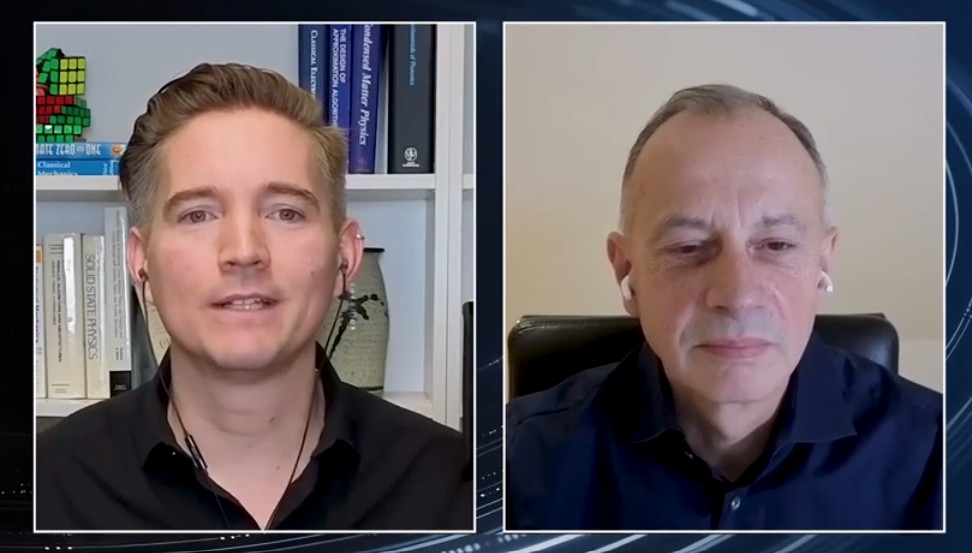
00:00:02Martin Hofmann: If you look at the problem that you have with traffic, it's a traveling salesman problem multiplied because you have to find the best path for every single vehicle. So it became very obvious that traditional computing might break. What we learned about quantum computing at that time very early for us, we were beginning to understand, but we had the feeling pretty quickly and also the proof in the end that this is a perfect application where quantum computing and the logic behind can be the game changer.
00:00:37Murray Thom: Hello and welcome to the premiere of Quantum Matters, where quantum computing gets real, a brand new podcast from D-Wave. My name is Murray Thom, and it's my pleasure to be your host as we move past the hype and the theoretical to explore practical real world applications of quantum computing today. On every episode, I'll be speaking with business leaders, scientists, academics, and other pioneers who have experienced quantum computing and seen its transformational impact. It's my hope that by illuminating the relationship between classical computing, quantum and AI, you'll gain a better understanding of how all these technologies work together to solve complex problems today and where the biggest opportunities lie in the future. So let's open the box and see what's possible.
Contrary to what you may have seen on TV, quantum computers aren't bending time or opening up the multiverse, but they are capable of solving complex computational problems from optimizing logistics routing to streamlining manufacturing processes. On this episode, I'm excited to explore the intersection of technology and impact and discuss how businesses can identify problems where cutting edge solutions like quantum computing can produce meaningful outcomes. Joining me for today's conversation is a man I've known for many years. He's a global technology executive who's led large scale digital transformations across manufacturing, enterprise software, and mobility, with senior leadership roles at Salesforce, Volta Trucks, Volkswagen, and more. Martin Hofmann, it's great to see you again. Welcome to Quantum Matters.
00:02:11Martin Hofmann: Hey, Murray. Great to see you again.
00:02:13Murray Thom: So Martin, when I'm thinking about quantum computing, I have been working at D-Wave for 23 years, and there was definitely a shift that occurred, and it was a shift from really understanding the quantum computing towards real world applications, and you were an important part of that story. So that's what I'm hoping we can kind of shed light on and discuss in that form of technology development. And I want you to give a little bit about your background and when you first started thinking about quantum computing technology.
00:02:39Martin Hofmann: So when I started with VW 20 years ago and the nine years of last years I was group CIO, that was the early days of AI. And I did a tech tour for Silicon Valley with my leadership team and we were looking at the next potential exponential technologies, what is out there. And quantum computing at that time was potentially one of the new hyperscaling technologies out there. So basically that's when we met you guys at D-Wave and looked into potential applications. And what crossed my mind was when you talked about quantum computing those days, it was super academic. So basically it was prime number crunching and all kinds of simulation and not touching people. And so we are practitioners. At VW, we are building cars, put them on the road and people should love them and drive them. So the question is how to use it in the real world, in our world of mobility. This is where it first crossed our mind to look deeper into use cases that really touch people.
00:03:42Murray Thom: It's so fascinating because Volkswagen obviously produces a lot of vehicles. And when you and I were talking, you were talking about the mission from the perspective of mobility. And also from my experience, just like you were saying, a lot of my conversations with researchers who were exploring quantum computing was, how do I take problem sets like the icing model and translate it into maximum independent set or minimum vertex cover? Those were sort of classes of problems that were known to be computationally hard. And what you did is you said, "Hey, I want to connect this to traffic flow." We all experienced moving through traffic. I want people to think about this as a tool. I want to explore how we can use this as a tool to help us get from downtown to the airport more effectively. And that really transformed our mindset and actually set off a cascade in that direction. What helped you to see that that was the critical event that needed to take place in quantum computing?
00:04:40Martin Hofmann: Being a practitioner, the most important thing is the outcome. What is it that you want to accomplish and how does that help to make things better? And in the case of traffic, the outcome was the objective that we were looking at, not how to get through a traffic jam or how to minimize traffic, but to completely avoid the traffic jam. And that was the outcome we targeted, getting people from A to B and a traffic jam before it happens to dissolve it, right? It never happens. So if that's the objective, the question is how to get there. And that's where we saw in quantum computing a big opportunity because of the ability to parallel, calculate instantaneously the best routes, the best paths that you could have through traffic. This was pretty clear to us at the moment we saw it, this should be our first use case, our MVP1.
00:05:34Murray Thom: What was your experience with the limits of technology at that point? I mean, you were looking at traffic flow. Certainly that's something that in our lifetime, we've just seen a transformation in terms of the availability of information about what's happening with traffic. How did that transform when you were sort of looking at the availability of information into how do you act more effectively with it or anticipate it?
00:05:56Martin Hofmann: If you look at the problem that you have with traffic, it's a traveling salesman problem multiplied because you have basically every single car in traffic needs a traveling salesman solution to find the best path for every single vehicle. So it became very obvious that traditional computing might break. What we learned about quantum computing at that time very early for us, we were beginning to understand, but we had the feeling pretty quickly and also the proof in the end that this is a perfect application where quantum computing and the logic behind can be the game changer.
00:06:34Murray Thom: Well, the interesting thing was that when we're trying to optimize our route moving through traffic, we can all make independent decisions. But when we do that, we might move off of a congested route into another route and then congest it. And then we haven't necessarily solved the problem. And what I really appreciated was this idea of let's coordinate the decision making. And that's really where classical computing runs into challenges is when that decision making has to happen over a wide group of resources where you're trying to make decisions and take into account the actions of others. This is what I think is going to surprise people. I mean, we were looking into this in 2016. So can you tell us a little bit about that first project we were working on in terms of what we were trying to demonstrate in the dataset that was getting used there?
00:07:19Martin Hofmann: The first idea was to use real life data. We got a dataset from Beijing taxis like geopositions and the movement of those taxis in a segment of the city. So if you know Beijing a little bit, there's an area downtown from there to the airport, this is like congestion area. I have to say this is 10 years ago, right? Today with the development in China, maybe they don't have traffic jams anymore, but at that time, that was it. And so we took the data and the idea was using classical computing and quantum together. So with classical computers, high performance computers, we were predicting where traffic might accumulate based on the movement data we got from the taxis. And once we knew that where traffic will accumulate, then we moved over to the D-Wave machine and basically used quantum technology to optimize, to dissolve it, to use, as you said, per every single individual, a traveling salesman approach. And the restriction was you cannot give the same route to two cars because otherwise you send them all into the next traffic jam, right? So both paradigms, and we called it at that time, hybrid quantum computing, worked together really well.
00:08:34Murray Thom: Folks who are in the quantum computing industry tend to make it more complicated than it needs to be. Certainly as you're doing technology development, you're starting with building the devices themselves. And that can give you a bit of a narrow focus so that when you're at parties, you start telling people about the thing that's right in front of you. When I was able to start sharing about that project in 2016 and reducing congestion, traveling from downtown Beijing to the airport, the level of imagination that that awoke in the people that I was talking to was significant. The reaction was, "Oh, you can use this technology to solve real world problems." It was a demonstration that, yeah, there are relatable examples that can be used.
And folks in the automotive sector, folks in the airline sector moved into the space. Sigma I in Japan did a project where they were looking at the coordination of evacuation protocols. So they were using supercomputers to model how tsunamis would form after earthquakes. And then they were doing this optimization of let's get everyone out of this endangered sector in the most efficient way. And I just love that that idea helping to make that technology tangible led to those developments. And I think it has to do ... You spoke to me before about outcome engineering, thinking about the outcome that you want to produce. Is that a process that you use in all of your work? I mean, was that new for you at that time?
00:09:58Martin Hofmann: At that time, it was a new approach. I mean, typically you start any project with the business case and the business case, you do your calculations and based on a lot of assumptions, and they turn out mostly not to be correct. Business cases in IT are never correct, right? So basically you overestimate, underestimate. Outcome engineering has a different approach. You define the target picture and you work backwards from that target to the solution. So you solve traffic jam before it happens. This was the target, and that's where we worked backwards. And I'm using that also in AI projects. So these days, I'm very deep into agentic AI. I'm writing a book about it. And I describe outcome engineering as engineering art to really describe precisely what you want to accomplish and then work backwards. You still have KPIs and numbers. You don't chase any assumption. You chase the outcome that you intended. So that I think is a very, very important element in the work that I do, whatever I do. Since then, basically, this was teaching me as well.
00:10:59Murray Thom: This notion of outcome engineering, having that sense ... I mean, I have also seen that as a best practice in transformational projects where if you want to create some innovation, you've got a new capability, it's important to have a team member as part of that group, sort of like steering committee for the project, that team member who's basically got that eye on that outcome. Another important element for those projects is having the data itself with folks who are used to working with real world data, who understand how to put that together. How did you work with your teams to bring them in and bring that real world data component?
00:11:36Martin Hofmann: That's basically step two after Beijing was Barcelona. That was 2018. So after Beijing, it was super successful, by the way. We showcased at the computer fair in Hannover in 2017 together, by the way, to the public, to the world. And I think I've never seen so many reporters and writers and people at the booth and really seeing in real time how we did that because we were running the same simulations. So in 2018 was the world mobile congress, one of the biggest congress tech conferences for mobile computing and mobile phones, mobile communication in Barcelona.
And the idea was now let's get one step further and take live data from taxis and optimize the points with the highest probability there will be passengers to be picked up. In the area around the Congress center, always congested, taxis are somewhere, but not where they should be. So the idea was to reduce the time for a taxi driver to pick up a customer and for customers to wait for a taxi. I think about three minutes, something like this that we gave as a target and we made it. So this was the first time we could use live data.
00:12:45Murray Thom: One of the things I want to share with our viewers is that this kind of process and project has started to become commonplace, but what you're describing is the moment that it happened for the first time with quantum computing. And the influence that that had on D-Wave was that it was teaching us about a lot of practical experiences that all users who were building applications with quantum computers were going to have to go through. And we started to look at the technologies that we needed to bring together to make that easier, to make that process easier. And that led to a project in Lisbon, Portugal at the Web Summit.
00:13:25Martin Hofmann: Looking back, it was a crazy thing. It was super crazy. So the idea was using Web Summit in Lisbon, huge web conference, right? Great visibility. Many people, especially tech-savvy people, I think 40,000 people meeting for a few days to learn about technology. So the idea was to get one or two buses from the city of Lisbon and equip them with an iPad. So the driver basically gets an iPad on top of his NAF system and we do the same thing we did in Beijing and in Barcelona, we predict traffic, we predict the traffic jam and then calculate for the bus a route on the long distance trips to the airport, a route it should take to avoid the traffic jam.
And the city of Lisbon were crazy. By the end of the day, we got two buses and they were at Quantum Shuttle. They were totally overbooked. Everyone wanted to ride on the Quantum Shuttle, so they were lines standing and the bus driver got on the minute, every minute, a new update on his map on the iPad with a newly calculated route coming from D-Wave, from a quantum computer onto the screen of the bus. And so the outcome was 30% reduction in travel time at any given traffic situation on average that we could achieve.
00:14:44Murray Thom: I love thinking about this and telling this story because at that time, quantum computing is a relatively complicated product, right? It involves shielding, it involves refrigeration, it involves processor design, there's software and calibration and then formulating problems and generating the solutions. The interesting thing here was that here was an interplay between a group of technologies, iPads with live updates, real vehicle movements, making calls about traffic situations and re-optimizing. And it helped D-Wave to see our place in that ecosystem. And we worked a lot on technologies that came together just as you were pulling together a project so that we could provide fast, reliable service, the division of work between our quantum computers and classical computers, and that all came together in that project in a real world way. We had our colleagues, Kelsey and Shirley, a photograph of them in front of the quantum shuttle in Lisbon, Portugal. That again transformed imaginations because kind of like you were saying, you mentioned to me, it was in their seats, the effect of quantum computing, right? It was directly involved in changing direction.
00:16:02Martin Hofmann: The funny story was the drivers, right? They didn't trust second at the beginning, the new solution. They said, "We know the routes and we feel our stomach tells us because we are bus drivers when there's traffic." So in the end, we asked the drivers and they were blown away. They said unthinkable that an algorithm can do that better than we do. In some areas, the same. They would've chosen the same route, but in many, many situations, the algorithm was better, so it was really very cool.
00:16:31Murray Thom: I mean, Martin, that speaks to the challenges a lot of organizations face with change management. This is a system of humans and technology working together, and everyone feels a certain degree of discomfort when systems are going to change. I've certainly had lots of conversations with businesses where the operators themselves are really involved and it's very much that same conversation. Let's bring this up alongside what you're currently operating, giving you an opportunity to see how it works and to be able to use your knowledge, but also how that system's working to see the benefit that it can provide you and then execute that transition. I mean, have you seen the same factors in businesses where you've been operating about that change management process with innovation?
00:17:13Martin Hofmann: You read about it, you learn about it, and you run into it every single time. Also, my book I write about inertia. Inertia is a human element, right? It's very hard to get us humans moving. We are sitting comfortably in our cave. If we have enough food, we don't move. We don't move off the sofa when we feel comfortable. And to get out of this moment of inertia, things need to happen, and it's either a shock or it's something demonstrated that spikes your interest. I completely agree. This is a change management core problem that we all face. It will never go away. So the question is, how fast can you move and how fast can you activate people to change?
00:17:55Murray Thom: Martin, you've written a new book called The Agentic Enterprise: Building Organizations That Think, Act, and Learn Autonomously. And in that book, you talk about the convergence of agentic AI and quantum computing. Can you tell us a little bit about your thoughts there?
00:18:08Martin Hofmann: Yeah, absolutely. The book is a playbook for organizations to transform on an architectural level, technical level, but also organizational level, and how to lead the transformation, the CEO, CIO, and CHRO. So if you look at how agents work, agents are basically LLM models that use tools to not only give you back an answer, but we are able to execute. And through the execution, they're also able to learn. When I look into the tools available that an agent can use, quantum computing is offering a new dimension, and there's one chapter in my book, which is called Agents Running at Quantum Speed. It's about agents using through the model context protocol, which was built by Antropic. That allows agents to call any tool. And what that means is an agent now can say, "Look, for optimizing a supply chain situation or a traffic situation, I'm going to call a D-Wave computer and the algorithm, move over the data and the objective, the outcome that I want, and get in a split second, the result back, and then I continue my work."
So if you think through that, that basically means you're turbocharging agentic AI, because suddenly agents, they don't have to develop and invent their own optimization algorithms. They use the most precise, fastest algorithm out there. So that's why I think quantum computing is really going to power agents in a completely new way. And this is not science fiction. MCP is technology of today. And with MCP, I can call any server. I can call a D-Wave server and activate an algorithm by handing over data and getting back a result. That's the beauty of it. Technology is there. It's doable. And this is giving those agents a brand new performance level.
00:20:06Murray Thom: It's fascinating. And I'm glad you shared that as well, because I certainly get a lot of questions about the intersection of artificial intelligence and quantum computing. And I think that part of what I'm sharing with folks is that quantum computing is like a form of computing hardware. It's solving problems for us. And artificial intelligence is a method for solving problems. So they're actually able to work together in a sense of just exactly like you're describing, sharing workloads or working together and accelerating those methods.
00:20:35Martin Hofmann: Right. And this is coming back to the idea of hybrid computing, where one is not replacing the other. It's a smart collaboration where you combine the best technologies, again, for an outcome. The outcome is what's all about. If I can reach it only with quantum computing, I will do that. If I need to have a combination, I will do that. It's irrelevant. The outcome is the objective, but getting that in quantum speed, this is really, I think, for many, many applications, think about energy, grid management, where you have latency, which is going close to zero, right? You cannot afford interruptions. And so you have a very low latency and quantum computing can provide that compute power to an agent, managing a grid, observing a grid, optimizing a power grid. So I think there are many examples and applications of today where it could be used.
00:21:34Murray Thom: That example you give, Martin, really resonates with me as well, because I often use energy grid management to help people to see the distinction between optimization applications that classical computers find easy versus the ones that they find very hard where quantum computing can provide a benefit. For instance, when we had traditional energy grids with a single central power plant and power radiating out from it, there was a lot of independent continuous optimization, which classical computers found easy. Now as we're moving to these modern energy grids that are decentralized, there's a lot of decisions that need to be made about, am I going to be drawing power from this location through solar panels or am I going to be pushing power? Am I going to be storing power into mobile cars that are in people's garages or am I going to be drawing from it during peak times? And those kinds of decisions affect all the other decisions you make in a network. So that resonates a lot with me. One of the patterns that I have seen in innovative technology projects is the importance of bringing operators with operational experience to an innovation project. People who are actually managing those business operations and you have created organizations and given them structure around innovation in your work at Volkswagen and other large enterprises, what would be your advice to other business leaders about how to set up that organizational structure to take advantage of that and get that innovation integrated?
00:23:02Martin Hofmann: Two things I believe are super important, and I learned it the hard way myself. So one is the pilot theater, the POC theater, I call it, right? POC, proof of concepts, pilots. So especially quantum computing, because people don't really understand, we didn't understand. So we went into a pilot and a pilot has, as an advantage, you can try things out, which is okay. But at the same time, there's no commitment because everyone knows if I don't like it, if it's not working 100%, I just kill it, right? I dump it in the next dumpster. So you go in already with the notion of it might not work, right? So that's number one. So this is why I think outcome engineering is so super important. Pick a target that you want, that you need to accomplish. You want to reduce outages of a network of a grid from 1% to 0.2%.
That's my outcome. So you're working towards a goal. And in many, many labs around the world, technical labs that companies build, and I built several myself. If you get stuck in a POC theater, you don't get anywhere. So that's why I'm promoting MVP1. MVP1 is this thing will go live and it will stay live and we will hit the target. If it takes two weeks, maybe six weeks, eight, I don't care. The target is the objective, the outcome. So that's what I would really recommend to pick something where you need to solve an issue, you need to solve this problem. And second of all, don't experiment around go and do it with the intention. Whatever you do stays. This is going to be our solution.
00:24:43Murray Thom: Very valuable. I mean, and I have seen how that mindset is critical to the project because a proof of concept for an organization is taking it from, "Hey, this is a novel technology that I'd like to explore, but I don't have solid business information about it yet." Two, at the end of that, with that intention of, I'm going to use this is, "Well, now I can get some really tangible return on investment information. I've tested it at my application scale. I've given it some real world scenarios." So not only have I built something that's useful, but I can also get valuable business data that's important for executives who are making decisions about adoption.
00:25:19Martin Hofmann: Yeah. I mean, there was a study coming out by MIT a few weeks ago, 95% of AI projects fail. And if you dig deeper why they fail, it's always the same pattern. It's there was no real commitment. It was POC theater, right? Trying things out. Oh my God, I didn't lead anywhere. Okay. And number two, no one really defined what the outcome was. What do you want to accomplish? Just to see if it works, great, right? It has to solve something. And that's the reason why. And the other 5% did it exactly the other way around. There was a clear outcome and it was also clear when we have it up and running, it's going to stay. It's an MVP.
00:25:56Murray Thom: Well, and also from the quantum computing side of it is the provider. It's shaping the development of our technology, right? So the process of going through that, I mean, the things that I've seen as build a D-wave to respond to the projects that you're talking about in order to be able to enable and support an application that's doing live rerouting of buses in Lisbon, Portugal during the web summit conference, is that we created a set of technologies that made it a lot easier to build those applications from that experience. And that had a big impact. I was part of the quantum stream at the creative destruction lab and helping businesses to look at quantum computing technology and how they could make new startup businesses and solutions for businesses. In that context, that's a very much like drive to survive type of environment.
You're starting quickly, you need to produce a product, you've got some very innovative folks and creating that technology stack to make it easier for people to build those applications was critical. And that mindset, those projects that you led helped us to create those and then those in turn ended up helping an entire ecosystem to explore applications. I mean, that's a fantastic ripple effect. A lot of folks who are going to be watching this podcast episode are approaching quantum computing and it's new for them. And so if you were thinking back to your early days exploring quantum computing, what advice would you have given yourself in terms of helping you to make progress quickly and see the path ahead of you?
00:27:21Martin Hofmann: Maybe we should have picked an easier MVP first, right? But no, I think I'm repeating myself. It's the same thing. I would really pick a problem to be solved, not for the sake of an experiment. I would not experiment. I would pick something. If I don't find something, I wouldn't even engage. The moment I want to engage is to really find what is that use case that is really doable, not too complicated, not too difficult. This is why it took us a year intervals to get from Beijing to Barcelona and from Barcelona to Lisbon because it was really highly complicated. Focus on what you really want to accomplish because that you can show that you can demonstrate. The result is always, you cannot argue success. People, if they see what happened, then they believe it. Everything in the lab, people don't believe because they know it's lab environment, but if it's a life issue that you solve, I think that's the key.
00:28:17Murray Thom: We're getting close to the end of our time, Martin. I want to ask you a question which is related to the vision for quantum computing is to use quantum effects to perform calculations that are too slow or too hard to do with classical computing. And as much as we struggle as humans to understand quantum effects, that means that to a computer, it is a resource. It's a resource that helps it solves problems. And it's kind of been my thinking over time that if we can turn a resource that we have a hard time understanding into something that can do real work for us, it can help us understand that technology better. Is there something about quantum computing that you feel that you understand better now having had a chance to experiment with it, have your teams experiment with it and try it out in these applications?
00:29:01Martin Hofmann: Yeah, maybe not throwing all the problems to quantum computer, but really to sort out as you outlined earlier, words really good at and use other technologies for the remainder. So to see quantum computing, not as a competitive technology to HPC or classical computing, and oh yes, there's a need for GPUs and there's a need for QPUs and there's a need for CPUs. And I think to weave them together in a smart architecture to solve your issues, your greater outcome that you want, I think that's the key.
I mean, I remember when we did our Lisbon project, there were so many scientists all over us, us Volkswagen, trying to prove that you can do it differently better. Yeah, that might be possible. Theoretically and academically, no one has shown it by the way. But anyway, no one has used a CPU to do the web shuttle prior check that we did with Quantum, right? So maybe you can and maybe you have similar results. The point is not to compete with technologies, but to stick them together. And every technology is contributing its best part to it. So I think that's what I learned and what I also recommend, not to see it as a replacing or competitive technology.
00:30:21Murray Thom: That's an excellent point. I'm glad you shared that because certainly now that there are applications in production that are using quantum hybrid technology, there's that knowledge available about where are the spaces where this could be used and benefit from that knowledge. Look to those examples like the example you talked about in terms of traffic flow, which is also related to transportation, logistics, final mile delivery, to help give people an intuition for those locations for quantum computing. Martin, I just want to thank you very much for taking the time to be on the show. Any final questions you wanted to ask or comments that you wanted to make?
00:30:53Martin Hofmann: Yeah, maybe comment. I think I never had really the opportunity to thank the D-Wave team for those three incredible projects in the years, we spent sweating together and also the teams on the VW side. I mean, they did everything. By the way, they got to use patent on the first patent in quantum computing for traffic flow management. Super proud of still today. And everyone at VW is still talking about the quantum project in Lisbon. This is still today one of the milestones we accomplished as technologists.
00:31:23Murray Thom: And the feeling is mutual. I know from looking at the smiles on the faces of Kelsey Hamer and Shirley Arconi at that time, and also even when I'm talking today with folks about that project, there's just a lot of deep appreciation. That's just such a clear sign of the value of technology developers working with their customers on real applications.
00:31:42Martin Hofmann: Great partnership. Thank you.
00:31:44Murray Thom: Martin, thanks for joining me today for sharing your knowledge, your experience with quantum computing and how it's been made real in a practical context. I'm sure that all of our audience and everyone here at D-Wave really appreciates you coming in and sharing that with us.
00:31:57Martin Hofmann: Murray, thank you so much. It was really a lot of fun to talk about the good old times and also what's ahead. Exciting times ahead.
00:32:05Murray Thom: I couldn't agree more.
00:32:06Martin Hofmann: Thank you so much for the invitation.
00:32:06Murray Thom: We've covered a lot of ground today. What stands out for me most in my conversation with Martin is the importance of working on real world projects. When you're bringing innovation into technology, you need to have a stakeholder who's thinking about the ultimate outcome that you want to produce. You're creating it with the intention that you're going to use that project work. And that's because those projects take you from exploring a new technology you know little about to fitting it into your business IT infrastructure and getting some concrete information that your business can use to make decisions about how they're going to be using it in the future. Those projects, I mean, they're not just the benefit of the project themselves.
They shape both the direction your business is going to take and also the technologist itself. From D-Wave's perspective in quantum computing, we've built technology stacks that have learned from those lessons and altered the development of quantum computers in order to have them have a better impact on those customer problems. And in addition, we talked about the convergence of quantum and AI, and I know we'll be talking more about that in the future. That's it for this episode of Quantum Matters, brought to you by D-Wave. A huge thanks to you, our viewers and listeners for joining me. Please follow so you don't miss an episode, and to learn more about the exciting work we're doing at D-Wave, you can visit dwavequantum.com. Until next time, I'm Murray Thom. Stay curious about your quantum reality.